

Where it fits
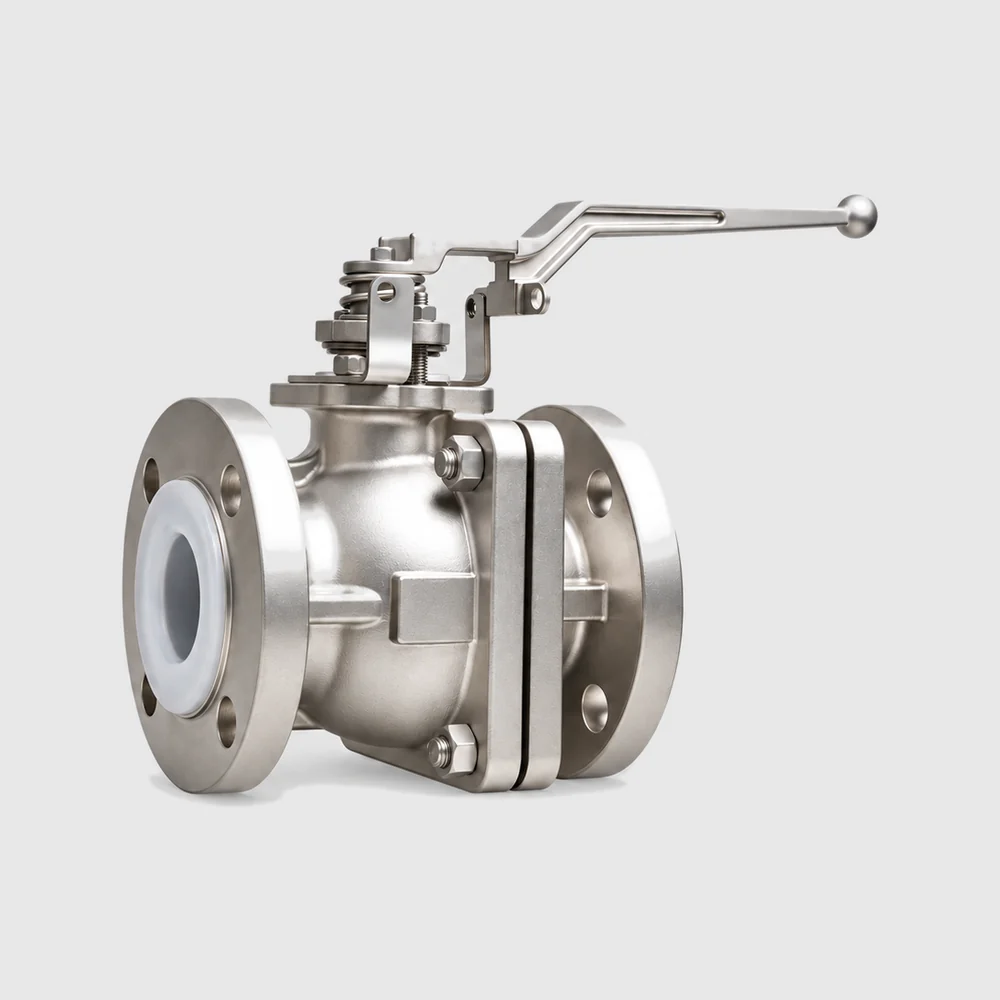
The ball valve is a common on/off valve in any piping system: fully open it is close to a straight pipe with low pressure drop, and a quarter turn of the lever opens or closes it completely. The PFA-lined version brings those advantages to corrosive service — the stainless shell carries the pipe loads, the interior is fully PFA-lined and the ball is high-purity PFA, so the fluid never touches metal. It is used on semiconductor, electronic chemical, pharmaceutical and corrosive industrial lines.
Typical locations are tank outlets, either side of a pump, shut-off points on branch lines, and anywhere equipment has to be isolated quickly for maintenance. These positions want the valve either fully open or fully closed; none of them needs flow adjustment.
Key characteristics
A lined ball valve is designed so that the metal and the fluoropolymer each do the job they are good at:
- Two-piece body: a 316L / 304 stainless steel shell, fully PFA-lined inside, combining the mechanical strength of metal with the chemical inertness of a fluoropolymer.
- High-purity PFA ball: the closure member is fluoropolymer too, so nothing metallic touches the fluid when the valve is closed.
- Ultra-low ionic extractables: resistant to acids, alkalis, chemicals and steam. PFA resin can be specified to suit the cleanliness requirement — an ultra-pure grade from a leading international resin maker, or a cost-effective high-purity grade — with material certificates.
- Fast operation: a manual quarter-turn lever, whose position shows at a glance whether the valve is open or closed.
Choosing between options
Two valves in this category are often compared with this one: the diaphragm valve with the same flanged ends, and the Hastelloy ball valve that uses Tri-Clamp connections instead.
| Aspect | Flanged ball valve (this series) | Flanged diaphragm valve | Tri-Clamp ball valve |
|---|---|---|---|
| Shell | 316L / 304 stainless steel, two-piece | 316L / 304 stainless steel | Hastelloy C |
| Sizes | DN25 – DN100 | DN15 – DN100 | DN25 |
| Connection | Flanged | Flanged | Tri-Clamp, BPE-based design |
| Design temperature | -20 to +120 °C | -20 to +150 °C | -30 to +150 °C |
| Best suited to | Large-bore isolation points needing low pressure drop and fast operation | Particle-laden fluids, pneumatic normally-closed duty, or ultra-pure lines sensitive to hold-up | Small-bore lines that are taken apart for cleaning |
Temperature is the first thing to check on this valve: the limit is +120 °C, lower than the diaphragm valves in the same category, so when the process runs close to it, choose the PFA-lined flanged diaphragm valve instead. For a DN25 line with Tri-Clamp connections, see the PFA-lined Tri-Clamp ball valve.
Operation & change-out
Installation and bolting follow the same rules as the other lined valves: protect the PFA sealing faces from knocks and scratches, tighten the flange bolts evenly in a cross pattern over several passes, and re-torque once after the first heat-up. A quarter turn closes the valve completely, so on long lines running at high velocity a fast closure causes water hammer, and the pressure surge hits the lining and the fittings — turn the lever smoothly.
The cavity between the ball and the body holds fluid when the valve is closed. Before changing media or opening the line for maintenance, set the valve briefly to half-open while flushing so that the cavity is rinsed out too, then return it to fully open or fully closed. The design pressure is a 20 °C figure and falls as temperature rises, so confirm hot service against actual conditions.