



Where it fits
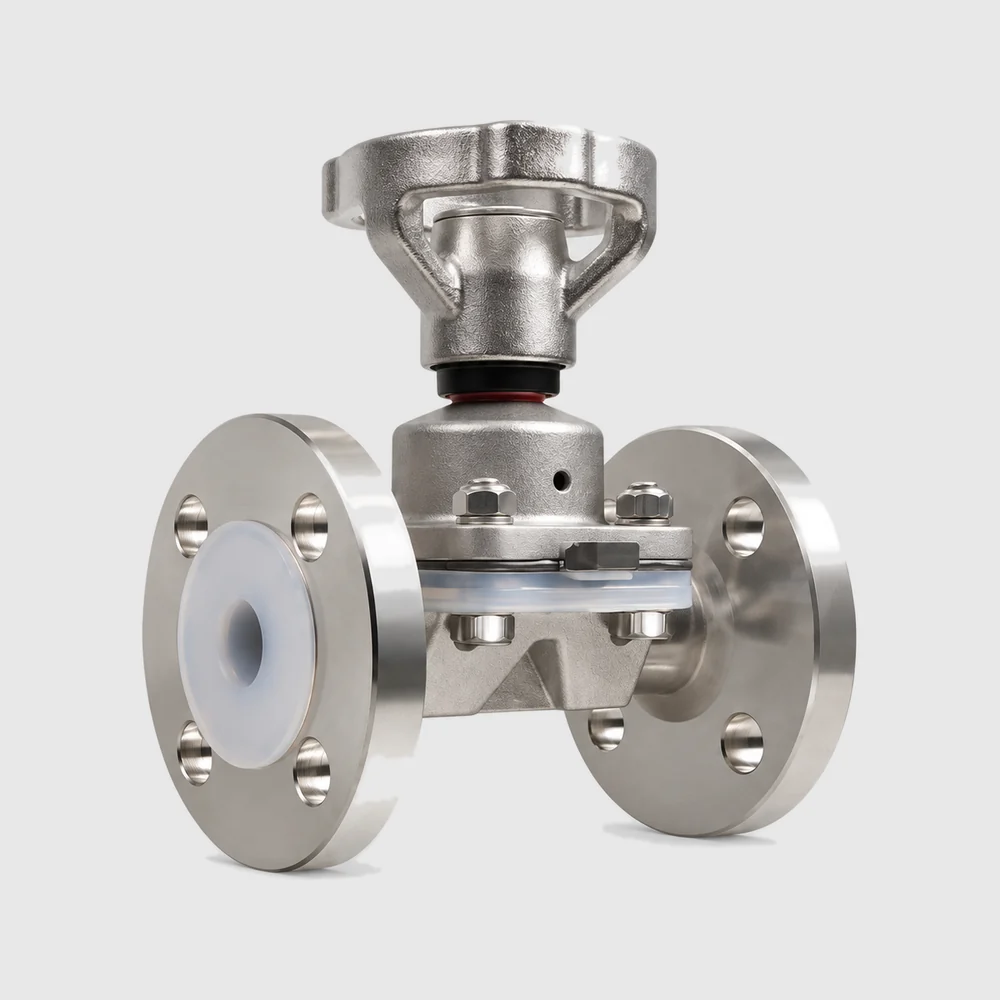
This valve goes on the delivery lines of a fab's CDS (chemical distribution system), on ultra-pure wet-process fluid lines, and on display and solar wet-process lines, where it handles on/off and isolation duty. The problem it solves is simple: those lines carry strong acids, alkalis and high-purity chemicals, and any metal on the wetted surface slowly leaches ions into the fluid, which becomes background contamination for the process downstream. An all-plastic valve, on the other hand, cannot hold flange bolt load and pipe stress over the long term. A PFA lining lets the stainless shell provide the strength and the PFA handle the fluid — each doing what it is good at.
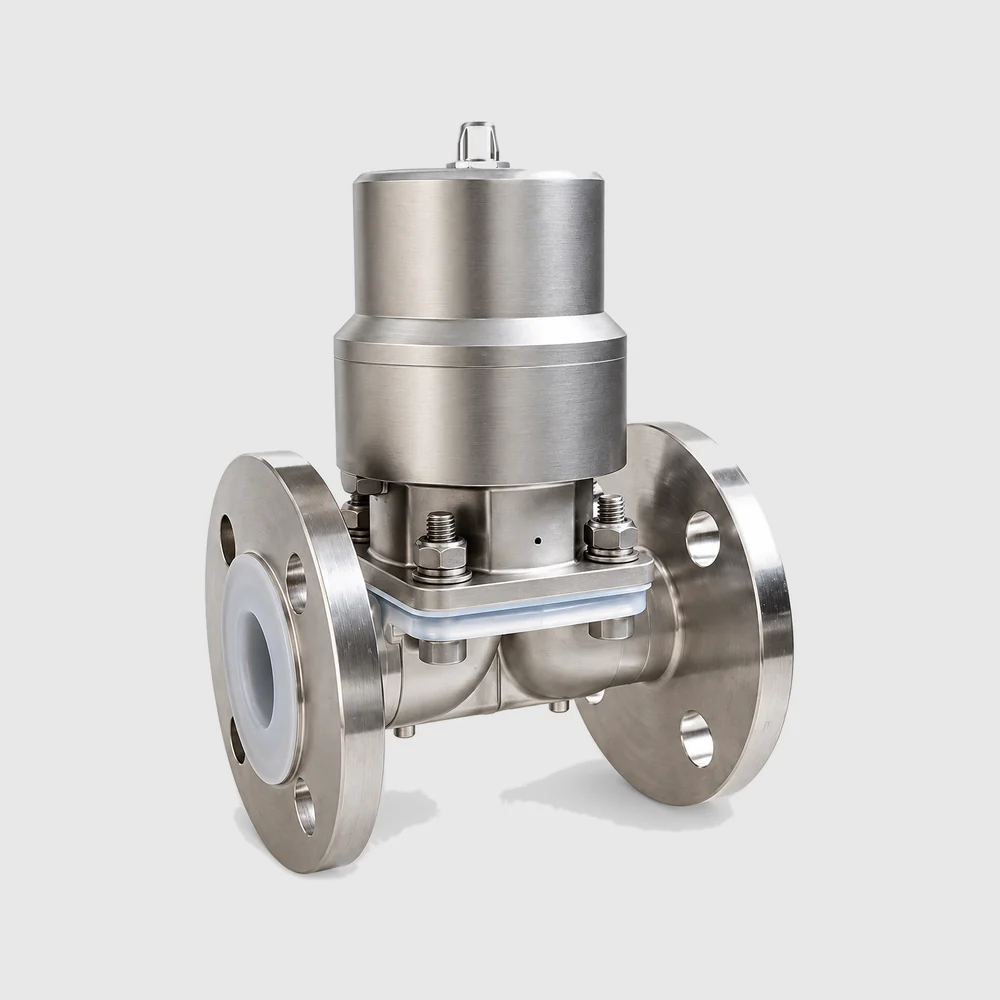
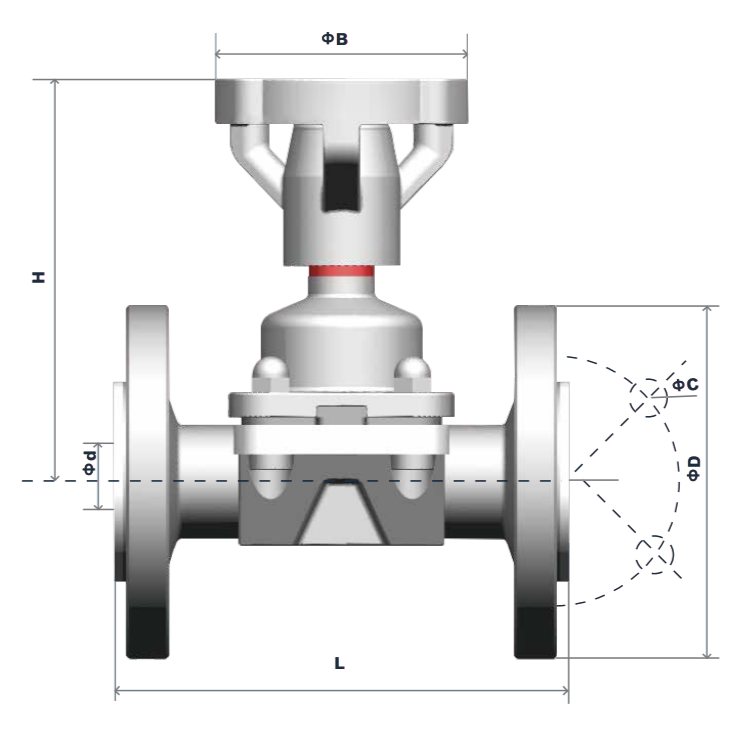
The manual version covers DN15 to DN100 for isolation points on mains and branches; the pneumatic normally-closed version comes in DN20, 25, 40 and 50 for supply points that need remote or automatic control.
Key characteristics
The point of a diaphragm valve is that the fluid stays inside the body and never reaches the stem or the actuator. This series is built around that:
- Fluoropolymer wetted path: high-purity PFA lining on the body and a PTFE diaphragm face, so the fluid never touches metal. Very low extractables, broad fluid compatibility, and resistance to acids, alkalis, chemicals and steam.
- One diaphragm for shut-off and sealing: the PTFE / EPDM composite diaphragm has PTFE facing the fluid and EPDM behind it for resilience. The stem never contacts the fluid, so there is no stem-packing leak path. It isolates ultra-pure fluids well and shuts off dependably in any operating state.
- Straight-through flow path on the pneumatic version: fewer dead zones, no stagnant fluid and a lower contamination risk. The stainless pneumatic actuator is normally closed, with a limit switch and an anti-static build as options.
- Specifiable resin grade: PFA resin can be specified to suit the cleanliness requirement — an ultra-pure grade from a leading international resin maker, or a cost-effective high-purity grade — with material certificates. The pneumatic version also comes with FDA and ionic-extractables test reports.
Choosing between options
Choose the valve type first, then manual or pneumatic. Diaphragm and ball valves both do on/off duty, but their flow paths differ, and so do the fluids they suit:
| Aspect | Flanged diaphragm valve (this series) | Flanged ball valve |
|---|---|---|
| Flow path and hold-up | The diaphragm closes onto the seat, leaving no cavity to trap fluid; straight-through path on the pneumatic version | Close to a straight pipe when fully open, with low pressure drop; the cavity between ball and body traps fluid when closed |
| Particle-laden fluids | Suitable — particles do not jam the diaphragm face | Particles can lodge between ball and seat, scoring them and causing seat leakage |
| Operation | Multi-turn handwheel that allows rough flow adjustment, or pneumatic normally closed | Quarter-turn lever for fast on/off; not recommended for throttling |
| Sizes and temperature | DN15 – DN100; -20 to +150 °C | DN25 – DN100; -20 to +120 °C |
Manual versus pneumatic comes down to control: if the valve has to tie into automation, or must close by itself when air is lost, choose pneumatic normally closed (NC). This series has no normally-open version; if you need one, or the line uses Tri-Clamp connections, see the PFA-lined Tri-Clamp diaphragm valve. For large-bore isolation points that call for low pressure drop and fast operation, see the PFA-lined flanged ball valve.
Operation & change-out
Check the flange standard before installation: the flanges follow HG/T 20592 (dimensions per EN 1092-1 PN16), and the bolt holes do not necessarily line up with JIS or other standards, so do not mix them. Protect the PFA sealing faces from knocks and scratches during handling and installation, and tighten the bolts evenly in a cross pattern over several passes rather than in one go. Fluoropolymers creep under load, so re-torque once after the first heat-up.
Flush with ultra-pure water before start-up until the downstream cleanliness meets specification. The design pressure is a 20 °C figure — the higher the temperature, the less pressure the lining can take — so for service that combines high temperature, vacuum and thermal cycling, send the medium, temperature and pressure to sales for confirmation. The diaphragm is a wear part whose life depends on cycling frequency, temperature and medium; check regularly for leaks at the bonnet and for diaphragm deformation, and replace it with a PTFE / EPDM composite diaphragm of the same specification.