


Where it fits
A check valve goes wherever the fluid must only travel one way: pump discharges, each branch before two chemical streams merge, and tank feed lines. The moment a pump stops, the column of liquid downstream starts to run back, carrying chemical from the line back into the pump or even the supply tank; where two branches at different pressures merge, the higher-pressure branch pushes its chemical into the other. A check valve needs no external power and closes automatically when the flow reverses, stopping that backflow.
This series covers semiconductor wet processing, electronic chemical delivery, fine chemicals, pharmaceutical lines, battery electrolyte lines and corrosive media of all kinds. High purity and corrosion resistance are the common requirements: a backflow device that leaches metal itself simply adds another contamination source to the line.
Key characteristics
- Self-acting: no air, power or operator needed — it opens under forward flow and closes automatically when the flow reverses.
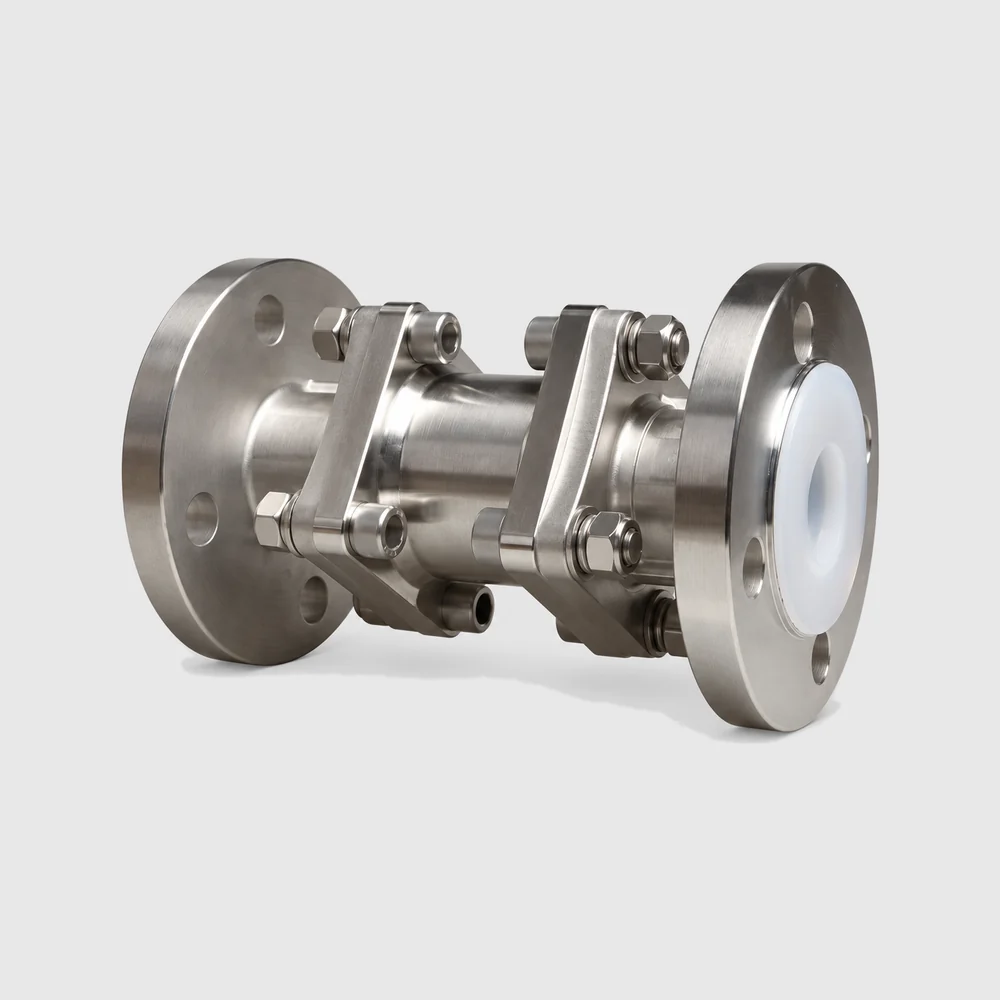
- All wetted parts in high-purity PFA: the fluid never touches metal. Low extractables, with FDA and ionic-extractables test reports available.
- Stainless shell: the 316L / 304 stainless steel shell carries the pipe loads, for a robust construction and long service life.
- Anti-static option: for low-conductivity fluids, the anti-static version reduces the risk of charge build-up.
PFA resin can be specified to suit the cleanliness requirement — an ultra-pure grade from a leading international resin maker, or a cost-effective high-purity grade — with material certificates. The wetted surfaces resist acids, alkalis, chemicals and steam.
Choosing between options
A check valve is not an isolation valve: it controls direction, not shut-off, and may pass a small amount in reverse when closed. In practice it is paired with a valve that can be shut by hand:
| Location | Recommended arrangement | Why |
|---|---|---|
| Pump discharge | Check valve plus a downstream isolation valve | Stops backflow when the pump trips; the isolation valve shuts the line for pump maintenance |
| Two chemical streams merging | A check valve on each branch | Stops the higher-pressure branch pushing its chemical into the other and cross-contaminating it |
| Tank feed line | Check valve plus a feed isolation valve | Stops the tank contents running back into the supply line |
For the isolation valve, choose the PFA-lined flanged diaphragm valve or the PFA-lined flanged ball valve according to the medium: the diaphragm valve for particle-laden fluids or ultra-pure fluids sensitive to hold-up, the ball valve for large-bore points that need fast operation. The anti-static version is recommended where low-conductivity fluids (organic solvents, ultra-pure water) flow fast, or where flammable solvents are carried.
Operation & change-out
It must be installed with the flow direction — fitted backwards, nothing gets through. Whether horizontal or vertical runs are acceptable, and how much straight pipe it needs upstream and downstream, depend on the internal design, so send the piping layout with your enquiry. Flange bolting follows the same rules as the other lined valves: protect the PFA sealing faces, tighten the bolts evenly in a cross pattern over several passes, and re-torque once after the first heat-up.
A check valve needs enough forward flow to open fully and steadily; at persistently low flow the closure member flutters at part-open, wearing faster and making noise, so size it on the actual flow rather than on the pipe size alone. The design pressure is a 20 °C figure and falls as temperature rises. There is no external position indicator, so include "is there backflow downstream after the pump stops?" in routine checks.