
Where it fits
The quality of a chemical or ultrapure fluid is ultimately proven by sampling: incoming acceptance, concentration tracking in a tank, particle and metal background monitoring on a line. Yet the sampling point is often treated as a minor part and fitted with whatever small ball valve is to hand — and then the valve's own wetted materials, crevices and residue end up in the very sample you are trying to measure.
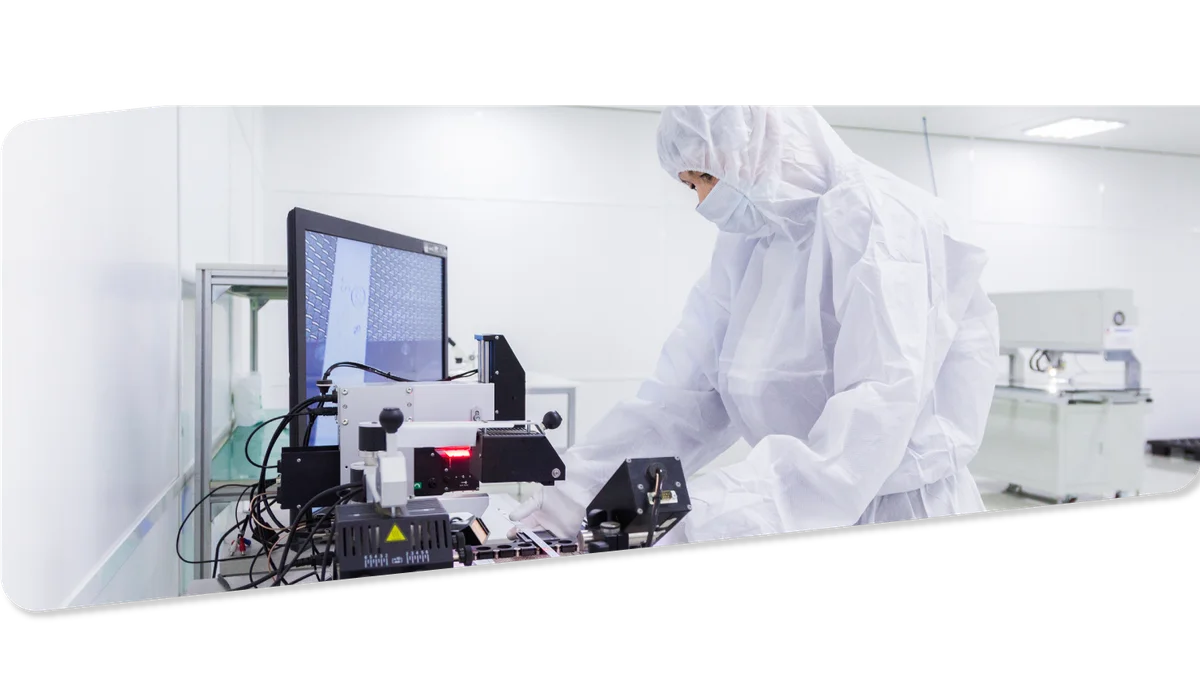
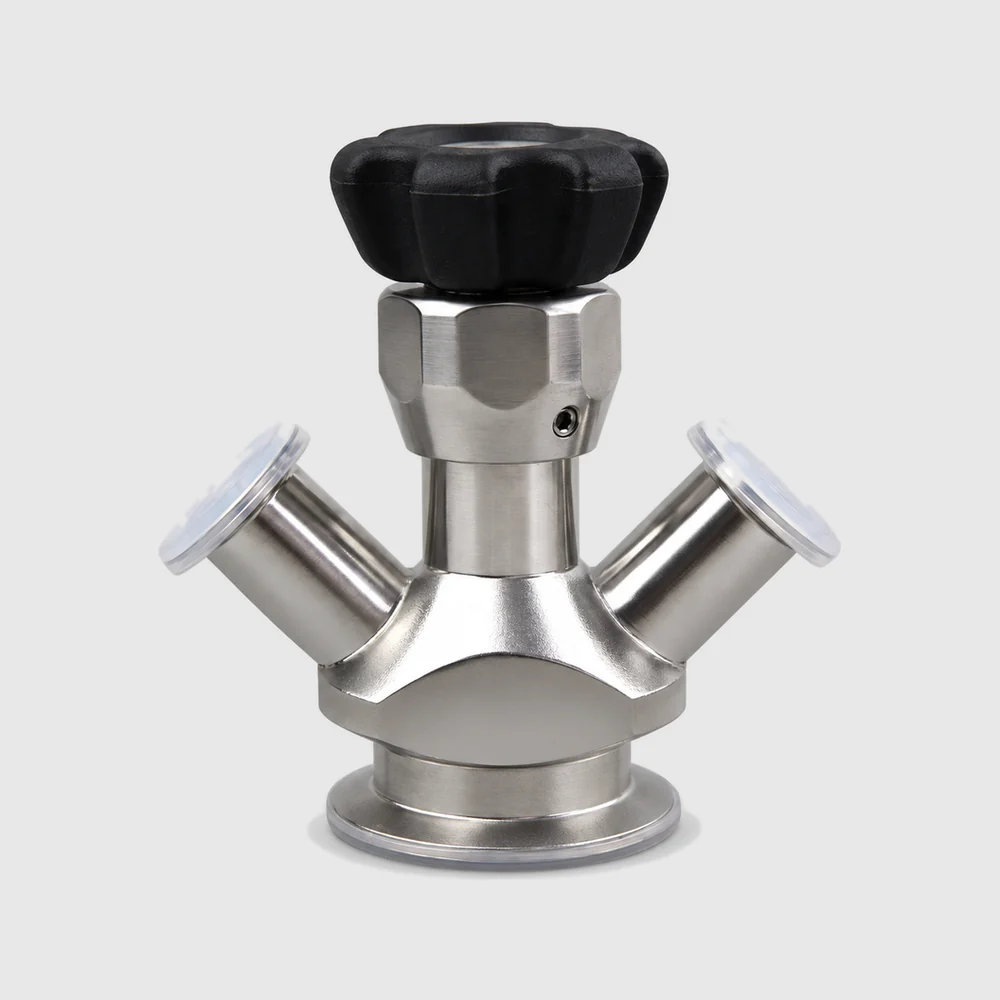
This dual-port sampling valve has a high-purity PFA-lined flow path and PTFE seals — the same material class as the PFA lines around it — so the sampling point does not add a metal contact surface of its own. It suits semiconductor chemical distribution systems (CDS), ultrapure fluid lines in wet processing, display and solar wet-process lines, and pharmaceutical lines designed to the BPE standard. For the measurement side, see how ICP-MS evaluates metal extractables.
Key characteristics
- Dual-port layout: two angled Tri-Clamp outlets plus a Tri-Clamp port at the bottom. The angled outlets leave room for a sample bottle or hose, and having two of them lets sampling and flushing take separate paths.
- Fluoropolymer wetted surface: high-purity PFA lining throughout the flow path with PTFE seals. The outer body is 316 stainless and the manual actuator is cast 316 stainless, operated by the black handwheel on top.
- Sanitary-style connections: every port is Tri-Clamp, designed to the BPE standard and FDA compliant, so the whole sampling point can be removed for cleaning.
- Operating envelope: resistant to acids, alkalis, chemicals and steam; -30 to +150 °C; vacuum to 1.0 MPa (at 20 °C). The PFA resin can be specified to suit the cleanliness requirement — an ultra-high-purity grade from a leading international brand, or a cost-effective high-purity grade — and material certificates are available.
Choosing between options
Choose the wrong sampling point and the cost is not a broken valve but data you cannot trust. The usual options compare like this:
| Sampling method | Strength | Watch out for |
|---|---|---|
| This dual-port sampling valve (JY-VLC6) | PFA / PTFE wetted surface; two outlets separate sampling from flushing | Manual only; DN25, DN40 |
| Small ball valve tapped into the line | Parts are easy to source | The ball cavity tends to hold residue, and the wetted materials need checking separately |
| Sampling straight from the tank bottom valve | No extra sampling nozzle needed | You get liquid from the bottom, which may not represent the whole tank, and any settled solids come out with it |
DN25 and DN40 are the nominal sizes of the valve; for the size of the bottom port and of each sampling outlet, give the line size at the mounting point with your enquiry and our sales team will confirm. Where the sampling point is on a vessel, its nozzle can be planned together with the PFA-lined vessel.
Operation & change-out
Before taking a sample, bleed off a little to clear the fluid standing in the sampling path, then fill the bottle; afterwards, flush the path so residue does not carry over to the next sample. A common dual-port arrangement is one outlet for sampling and the other for a flushing fluid — confirm the actual hook-up against your sampling procedure with our sales team when enquiring.
When installing, keep the Tri-Clamp gaskets centred and tighten the clamps evenly. Check regularly that the handwheel turns smoothly and that the outlets do not drip when closed. PTFE seals gradually cold-flow under long exposure to heat, and the higher the temperature, the lower the allowable pressure — check hot, high-pressure duty with our sales team first.